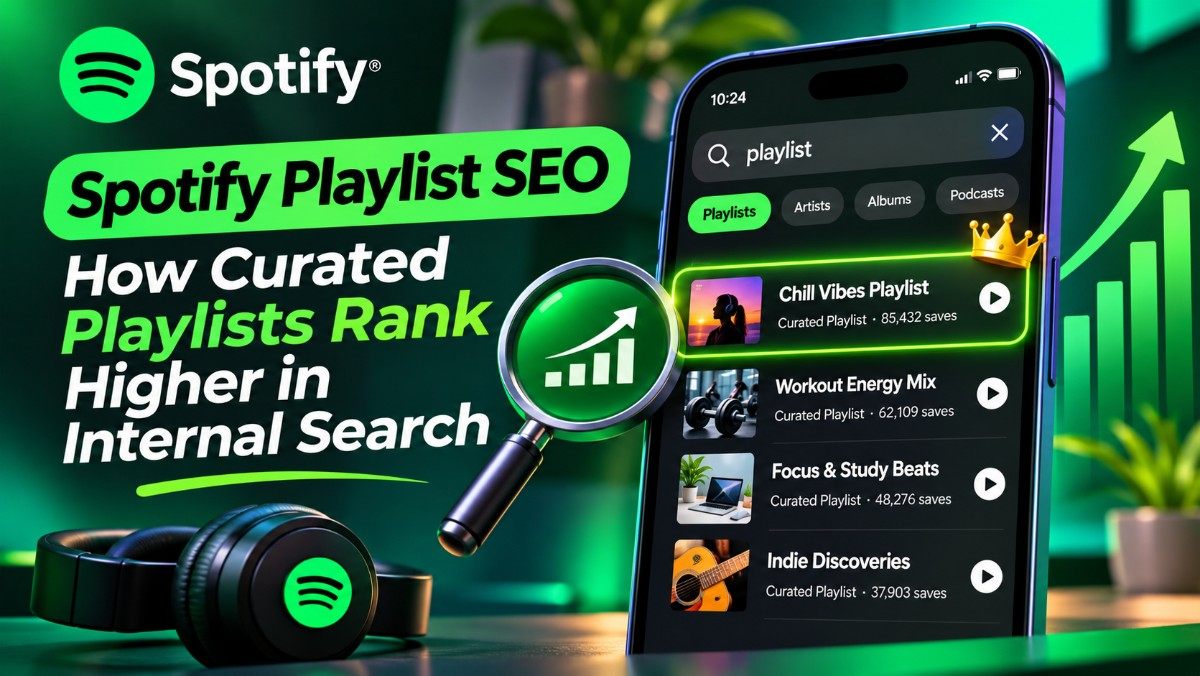
Landing an official Spotify editorial playlist is difficult for independent musicians, which is why thousands of artists, labels, and music marketers now build their own curated playlists to capture organic discovery. Because Spotify's search bar functions like a dedicated audio search engine—and well-optimized playlists increasingly appear in Google search results too—mastering Spotify Playlist SEO is one of the highest-leverage ways to drive recurring listeners to your catalog.
Spotify's internal search engine ranks user-curated playlists based on exact-match keyword titles, consistent weekly track updates, listener save rates, and total playlist follower counts. Curators build early search authority by matching mood-based search queries and maintaining steady follower retention without sudden drop-offs.
Which Metadata Fields Matter Most When Optimizing a Spotify Playlist Title and Description?
Your playlist title carries the highest text-relevance weight in Spotify's search engine, followed by the playlist description and the genre alignment of the artists inside your tracklist. Instead of guessing keywords, type your seed genre or mood into Spotify's search bar and record the exact autocomplete phrases listeners actually search.
High-ranking independent curators structure their metadata around three simple rules:
- Title formula (Clarity + Intent): Combine [Mood/Activity] + [Primary Genre]—for example, "Late Night Drive Lo-Fi Beats" or "High Energy Gym Hip Hop"—rather than vague branded names nobody searches for.
- Semantic description (Zero keyword stuffing): Use the 300-character description to naturally include secondary phrases, target activities, and 3–5 anchor artist names that define the sonic profile. Over-stuffed titles like "sad lofi chill study sleep beats" lower click-through rates and hurt search performance.
- Mobile-readable cover art: Use high-contrast, clean artwork that looks distinct at thumbnail size on smartphones, since click-through rate directly influences whether your playlist holds top search positions.
How Many Playlist Followers Are Typically Needed to Compete for Mid-Tail Genre Keywords?
Competing for broad head terms like "Workout Music" requires tens of thousands of followers against Spotify's own editorial lists, whereas mid-tail mood and activity keywords—such as "Indian Indie Road Trip" or "Deep Focus Instrumental Study"—often start ranking on the first screen once a playlist crosses 500 to 2,500 active followers with strong listener retention.
Follower count acts as a baseline credibility filter for both Spotify's search index and human listeners deciding whether to press play. When curators and music agencies launch a new thematic playlist, many establish an initial follower foundation through All Media Promotion alongside organic social sharing so the playlist does not sit at zero followers while competing in search results.
Why Does Weekly Track Rotation Prevent Playlists from Losing Spotify Search Visibility?
Spotify's ranking systems continuously evaluate playlist freshness and returning listener activity. Static playlists that go untouched for months gradually lose engagement velocity, causing active, regularly updated competitor playlists to overtake them in both internal search and personalized recommendations.
Building a repeatable weekly curation cadence takes less than 15 minutes and reinforces three positive ranking signals:
- Swap 3 to 5 tracks every week: Rotating fresh, genre-matched releases into the top 15 slots gives existing followers a reason to return and signals active curation to Spotify's indexing engine.
- Prune high-skip outliers: Remove tracks that clash with the playlist's BPM, energy level, or language—genre inconsistency confuses Spotify's recommendation engine and increases early skips.
- Keep total length tight (40–80 tracks): Bloated 400-song playlists dilute listening depth; focused playlists maintain higher completion rates and repeat sessions.
How Do 30-Day Refill Playlist Followers (#2432) Compare to Unguaranteed No-Refill Servers?
Unguaranteed no-refill playlist follower servers often drop sharply within 48 to 72 hours during routine account purges, sending negative decay signals that stall playlist search visibility. By contrast, 30-day refill playlist followers (Server #2432) maintain stable follower counts and include a 1-click dashboard refill option if any drop occurs inside the coverage window.
For labels and independent curators managing multiple niche playlists, sourcing retention-backed followers through a dedicated Spotify SMM panel ensures consistent social proof while organic listeners discover, save, and replay your weekly track updates.
| Comparison Factor | 30-Day Refill Followers (#2432) | Unguaranteed No-Refill Servers |
|---|---|---|
| Retention Stability | High-retention profiles with 30-day coverage | Frequent 40%–80% drops within days |
| Refill Protection | Automated 1-click refill button in dashboard | No refill—requires re-ordering at extra cost |
| Playlist SEO Impact | Sustains steady follower count for search authority | Sharp count drops weaken playlist credibility |
| Best Use Case | Curated niche playlists, labels & artist hubs | Not recommended for active search-ranked playlists |
Frequently Asked Questions
How long does it take for a new Spotify playlist to appear in search results?
Public playlists are typically indexed by Spotify search within 24 to 72 hours of creation. However, ranking on the first screen for competitive mood or genre keywords usually takes 2 to 6 weeks of consistent track updates, follower growth, and low skip rates.
Does changing a Spotify playlist title reset its search rankings?
Frequent title changes force Spotify search to re-evaluate keyword relevance and can temporarily drop your position. Pick one clear primary keyword phrase—combining mood, activity, and genre—and refine your playlist description instead of repeatedly rewriting the title.
How many tracks should a curated Spotify playlist include for optimal SEO?
Most high-ranking independent playlists stay between 40 and 80 tracks (roughly 2.5 to 4.5 hours of cohesive listening). Keeping the top 5 to 10 songs tightly matched to the playlist mood minimizes early 30-second skips and improves session completion.
Grow Your Curated Spotify Playlists with Stable Retention
Explore 30-day refill Spotify playlist followers and paced track promotion with instant 0%-fee UPI and USDT wallet funding.
View Live Wholesale Catalog